
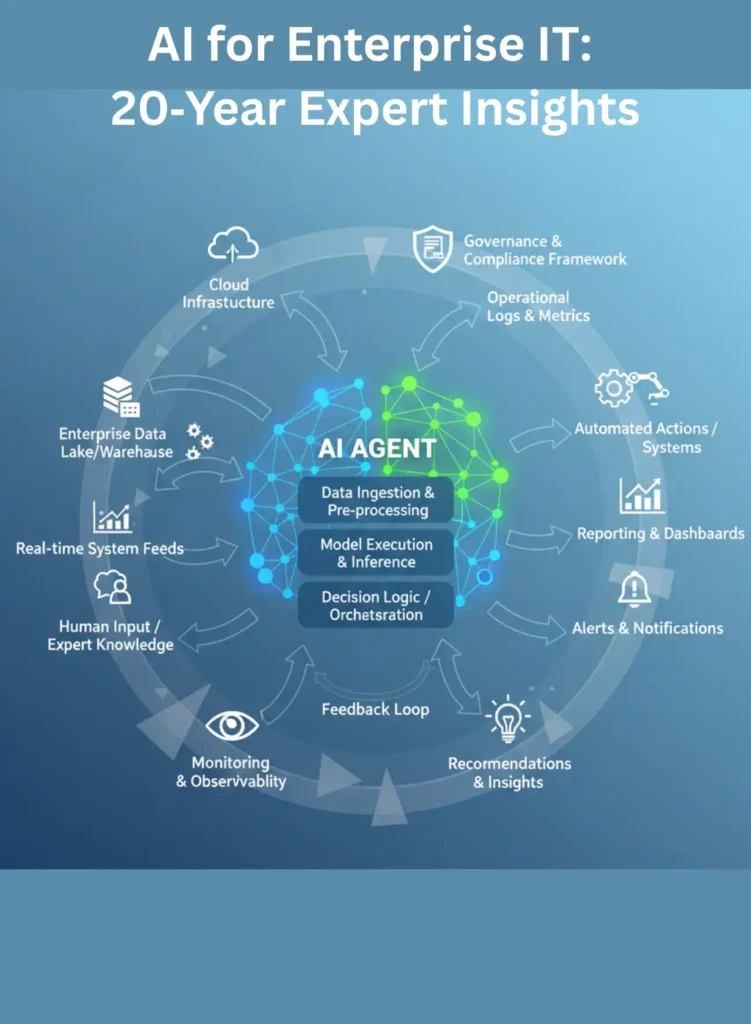
AI for enterprise IT why is matters now
From my experience, the shift isn’t about novelty — it’s about leverage. Over the last 20 years I’ve seen automation evolve from scheduled jobs and rules engines to models that learn from behavior and improve over time. This reminds me of a legacy modernization where a simple ML classifier reduced manual triage by 40% and unlocked capacity for higher‑value work. What most articles miss is that AI’s value in enterprises is rarely the algorithm itself; it’s the operational leverage — fewer manual steps, faster decisions, and better allocation of scarce human expertise.
In Simple Words AI becomes valuable when it reduces friction in existing processes and produces measurable business outcomes.
AI in enterprise IT is not a single technology you buy and flip on. It’s a set of approaches and tradeoffs that must align with your organization’s data maturity, risk tolerance, and operational model. Over two decades I’ve learned that the right question is rarely “Which model?” and more often “What measurable problem are we solving, and can we sustain it?”
What you will Learn in this Guide
How I decide whether to pursue AI on a project
I don’t start with technology. I start with the problem and the constraints. Over two decades, I’ve developed a decision pattern that helps avoid expensive detours and keeps stakeholders aligned.
- Start with the KPI: What metric will change? If you can’t name a KPI and a target, pause.
- Baseline first: Measure current performance with simple heuristics or rules. If a rule gets you 60% of the way, that’s a win.
- Prototype fast: Build a lightweight prototype in 2–4 weeks to validate assumptions.
- Assess operational cost: Consider compute, labeling, monitoring, and retraining overhead.
- Decide on interpretability: If auditors or regulators need explanations, prefer simpler models or explainability layers.
- Plan for maintenance: Models degrade; plan retraining and monitoring from day one.
From My Experience I’ve seen teams skip baselines and then claim “AI failed.” The truth: they never measured what success looked like.
People‑Also‑Ask — Micro Q&A Q: How quickly should I prototype an AI idea? A: Aim for a 2–4 week feasibility prototype that validates data availability and a measurable lift against baseline heuristics.
Core distinctions and practical implications
I use three practical lenses to separate concepts and guide decisions: scope, data needs, and operational cost.
- Scope — AI for Enterprise IT is the umbrella: automation, augmentation, and decision support.
- Machine Learning (ML) — practical for structured data and tabular problems; often the fastest route to measurable gains.
- Deep Learning (DL) — powerful for unstructured data (images, audio, text) but costlier and more complex to operate.
Practical implication: If your problem is “classify invoices” or “predict churn,” ML models often suffice. If your problem is “analyze millions of images for defects,” DL is the right tool — but only if the business case justifies the cost.
What most articles miss They focus on model accuracy and benchmarks, not on integration, retraining cadence, and the human workflows that consume model outputs.
People‑Also‑Ask — Micro Q&A Q: Is deep learning always better than machine learning? A: No. Deep learning shines with large unstructured datasets. For structured data and smaller datasets, traditional ML often gives similar or better ROI with lower operational overhead.
Project readiness checklist and gating questions
Before you commit budget, run this checklist. I use it as a gating mechanism to avoid sunk‑cost traps.
- KPI and target: Clear metric and expected improvement.
- Baseline measurement: Current performance documented.
- Data inventory: Sources, owners, quality, and labels.
- Prototype plan: 2–4 week feasibility prototype with success criteria.
- Operational plan: Deployment, monitoring, retraining, and rollback.
- Compliance review: Privacy, consent, and regulatory constraints.
- Cost estimate: Compute, storage, labeling, and people for 12 months.
- Stakeholder alignment: Who signs off on production and who owns the model?
In Simple Words If you can’t answer these in the first two weeks, don’t start building models yet.
Gating questions I ask at kickoff
- Can we define a measurable business outcome and a baseline?
- Do we have the data, or can we collect it within the project timeline?
- Who will own the model in production?
- What is the rollback plan if the model degrades?
People‑Also‑Ask — Micro Q&A Q: What’s the minimum data needed to start an ML pilot? A: For many structured problems, a few thousand labeled examples can be enough; for DL, expect tens of thousands unless you use transfer learning.
Architecture, tooling, and cost tradeoffs
Choosing the right stack depends on scale and constraints. I’ve moved from on‑prem Oracle systems to cloud‑native ML platforms; each choice has tradeoffs.
- Small to medium projects
- Tools: scikit‑learn, XGBoost, LightGBM.
- Architecture: batch pipelines, simple feature stores, containerized inference.
- Cost: low compute, modest storage.
- Large scale or unstructured data
- Tools: TensorFlow, PyTorch, Hugging Face, managed services (SageMaker, Vertex AI).
- Architecture: GPU/TPU training, distributed data pipelines, autoscaled inference endpoints.
- Cost: higher compute, specialized ops.
- Enterprise governance and lifecycle
- Tools: MLflow, Kubeflow, model registries, feature stores.
- Architecture: CI/CD for models, reproducible pipelines, audit logs.
From My Experience I once moved a prototype from a laptop notebook to a managed cloud service; the prototype cost was low, but production costs ballooned because we hadn’t planned for inference scale. Plan for production costs early.
People‑Also‑Ask — Micro Q&A Q: Do I need GPUs for ML? A: Not for most structured ML models. GPUs are essential for deep learning and large-scale training. For prototyping, cloud GPU instances are cost-effective.
Data, governance, and compliance realities
Data is the single biggest determinant of success. I’ve paused pilots because lineage was unclear; that pause saved us from biased outcomes.
- Data quality: completeness, consistency, and label accuracy.
- Lineage and provenance: track where data came from and transformations applied.
- Privacy: anonymization, consent, and retention policies.
- Governance: model cards, access controls, and review boards.
- Bias and fairness: test for demographic and sampling bias; document limitations.
This reminds me of a pilot where missing lineage forced a rebuild. It delayed the project but prevented a biased model from reaching customers.
People‑Also‑Ask — Micro Q&A Q: How do I handle sensitive data for AI projects? A: Use anonymization, differential privacy where needed, strict access controls, and keep sensitive processing within compliant environments.
People, process, and change management
AI projects are socio‑technical. The technology is often the easier part.
- Cross‑functional teams: combine domain experts, data engineers, ML engineers, and product owners.
- User training: adoption fails without user trust and training.
- Change management: update processes, SLAs, and roles.
- Governance rituals: model review boards, post‑deployment audits, and incident playbooks.
From My Experience We deployed a model that produced useful suggestions but users ignored them because the UI didn’t explain why. Adding a confidence score and a short rationale increased adoption dramatically.
Real project stories and lessons learned
I prefer storytelling over tutorials because stories reveal tradeoffs and human decisions.
Support ticket triage
- Problem: thousands of tickets, slow routing.
- Approach: start with keyword rules, then an ML classifier.
- Outcome: routing accuracy improved from 40% to 70%, resolution time dropped 30%.
- Lesson: incremental approach builds trust and reduces risk.
Quality inspection with images
- Problem: manual inspection bottleneck.
- Approach: collect labeled images, train a CNN, deploy inference at the edge.
- Outcome: 95% detection accuracy, throughput increased 4x.
- Lesson: labeling and edge deployment complexity must be budgeted.
Fraud detection in payments
- Problem: evolving fraud patterns.
- Approach: ensemble ML models with streaming features and human review.
- Outcome: reduced false positives and faster investigations.
- Lesson: hybrid systems (rules + ML) often outperform pure ML in adversarial domains.
From My Experience Hybrid solutions — rules plus ML — are often the fastest path to production and trust.
Monitoring, observability, and model health
Models are not “set and forget.” I treat them like services.
- Key metrics: accuracy, precision/recall, drift, latency, and business KPIs.
- Monitoring tools: Prometheus, Grafana, MLflow, Seldon, or cloud provider monitoring.
- Alerts: data drift, performance degradation, and latency spikes.
- Human‑in‑the‑loop: feedback channels for users to flag bad predictions.
- Retraining cadence: scheduled or triggered by drift thresholds.
In Simple Words If you don’t monitor models, they’ll silently degrade and cost you trust.
People‑Also‑Ask — Micro Q&A Q: How often should I retrain models? A: It depends on data drift and business impact; set automated drift detection and retrain when performance drops below thresholds or on a scheduled cadence.
Cost, performance, and ROI signals
I evaluate projects by time to value and total cost of ownership.
- Time to value: how quickly will the model deliver measurable impact?
- TCO: compute, storage, labeling, and people costs over 12 months.
- Operational complexity: monitoring, retraining, and incident response.
- Business risk: regulatory exposure and reputational risk.
From My Experience I once shelved a DL approach because it cost 8x more and improved accuracy by only 1.5% — not worth it unless that 1.5% unlocked major revenue.
People‑Also‑Ask — Micro Q&A Q: How do I estimate AI project ROI? A: Include direct savings, time saved, error reduction, and incremental revenue; subtract compute, storage, labeling, and ongoing ops costs for a 12‑month horizon.
Practical templates and checklists you can copy
KPI template
- Metric name:
- Baseline value:
- Target value:
- Measurement method:
- Owner:
Prototype success criteria
- Minimum accuracy or lift:
- Latency threshold:
- Integration feasibility:
- User acceptance metric:
Model governance checklist
- Model card created: yes/no
- Data lineage documented: yes/no
- Bias audit completed: yes/no
- Retraining plan: yes/no
This reminds me of the time a one‑page KPI template saved a stalled pilot by forcing clarity on measurement and ownership.
Real Enterprise AI Use Cases I’ve Seen
Let me share what is actually working inside enterprise environments.
Intelligent Code Assistance
Tools like GitHub Copilot are improving developer productivity. But the real value isn’t code generation — it’s faster debugging and pattern suggestion inside legacy systems.
From my experience, Copilot is most powerful when:
- Working on repetitive boilerplate code
- Refactoring old Java modules
- Writing test cases
- Exploring unfamiliar APIs
But it still needs experienced oversight.
AI for Production Support
In large enterprise projects, support tickets consume enormous bandwidth.
AI models trained on historical ticket data can:
- Predict root causes
- Suggest resolution steps
- Categorize issues automatically
- Detect recurring patterns
This reduces MTTR (Mean Time To Resolve) significantly.
AI in Reporting & Analytics
Earlier, BI reports required heavy SQL, ETL pipelines, and visualization design.
Now AI-assisted analytics tools inside platforms like Microsoft Power BI enable natural language queries.
Instead of writing complex queries, business users can ask:
“Show me Q4 revenue trends for telecom clients.”
That’s enterprise productivity transformation.
AI for Project Risk Prediction
This is where I personally see massive potential.
AI can analyze:
- Sprint velocity
- Resource allocation
- Historical delays
- Change request frequency
And predict project risk early.
As a project manager, this is gold.
AI in Legacy Systems: The Hidden Goldmine
I currently work on a complex legacy Java Struts application integrated with Angular frontend, AWS infra, and Kafka messaging.
Many assume AI is only for greenfield cloud-native systems.
That’s incorrect.
Legacy systems hold years of structured data — that data is training fuel.
From my experience, AI can:
- Detect performance bottlenecks
- Suggest query optimization
- Identify unused modules
- Predict batch job failures
Enterprise AI is most powerful where history exists.
AI in Project Management & Delivery Governance
As a project manager, I see AI impacting:
- Effort estimation
- Resource planning
- Risk forecasting
- Budget deviation alerts
- Stakeholder sentiment analysis
This reminds me of early ERP adoption days. Many resisted structured planning. Today, ERP is standard.
AI-driven governance will become standard too.
AI + Cloud + Data: The Real Enterprise Stack
Enterprise AI is incomplete without cloud.
Platforms like Amazon Web Services AWS provide scalable compute and ML infrastructure.
The enterprise stack now looks like:
- Cloud infrastructure
- Data lake
- ETL pipelines
- ML services
- Monitoring dashboards
- Security layers
AI is not a standalone tool. It is a layered architecture decision.
AI Risk, Compliance & Governance Realities
Enterprise AI adoption must consider:
- Data privacy
- Regulatory frameworks
- Explainability
- Bias mitigation
- Security breaches
This is where leadership maturity matters.
Blind AI deployment can damage brand trust.
Controlled AI experimentation builds credibility.
Enterprise AI Strategy: Where Leaders Go Wrong
Common mistakes I’ve observed:
- Treating AI as a marketing initiative
- Running PoCs without scaling strategy
- Ignoring data readiness
- Underestimating change management
- Expecting immediate ROI
AI in Enterprise IT requires patience, structured pilots, and cultural transformation.
Practical Roadmap for AI Adoption
If I were advising enterprise leaders, I would suggest:
• Start with internal productivity use cases
• Clean and classify enterprise data
• Train teams on AI literacy
• Implement governance policies early
• Scale gradually, not aggressively
• Measure ROI with defined KPIs
Enterprise AI is a marathon, not a sprint.
Next steps and recommended actions
- If you’re a leader: pick one high‑value, low‑risk pilot and fund a 90‑day prototype with clear KPIs.
- If you’re a practitioner: run a data discovery sprint and build a 2–4 week prototype to validate assumptions.
- If you’re a stakeholder: insist on baseline metrics and an operational plan before approving production budgets.
In Simple Words AI for Enterprise IT succeeds when it’s tied to measurable outcomes, built with operational rigor, and adopted through people‑centered change. From my experience, that’s the difference between a pilot that impresses and a solution that endures.
About the author I’m a professional IT practitioner and blogger with 20+ years in software delivery. I’ve worked across roles from junior programmer to project manager and across domains including media & entertainment, pharma, retail, telecom, and automotive. My technical background includes Oracle Forms & PL/SQL, Java, .NET, MySQL, SQL Server, Power BI, Cognos, and modern cloud stacks (AWS, Kafka, Angular). Recently I’ve led complex legacy‑to‑cloud projects and completed training in Copilot, ChatGPT prompting, and GitHub Copilot. I write from hands‑on experience and focus on practical, production‑ready guidance.
Credibility cues
- Led cross‑functional teams and production deployments.
- Delivered measurable outcomes across multiple industries.
- Emphasize governance, reproducibility, and operational readiness.
If you found this useful, stay tuned. I will continue sharing grounded, experience-driven insights on AI and enterprise technology.
Also visit my blog page on ” Know it all series for what is AI ” which covers detailed explanation of AI.