
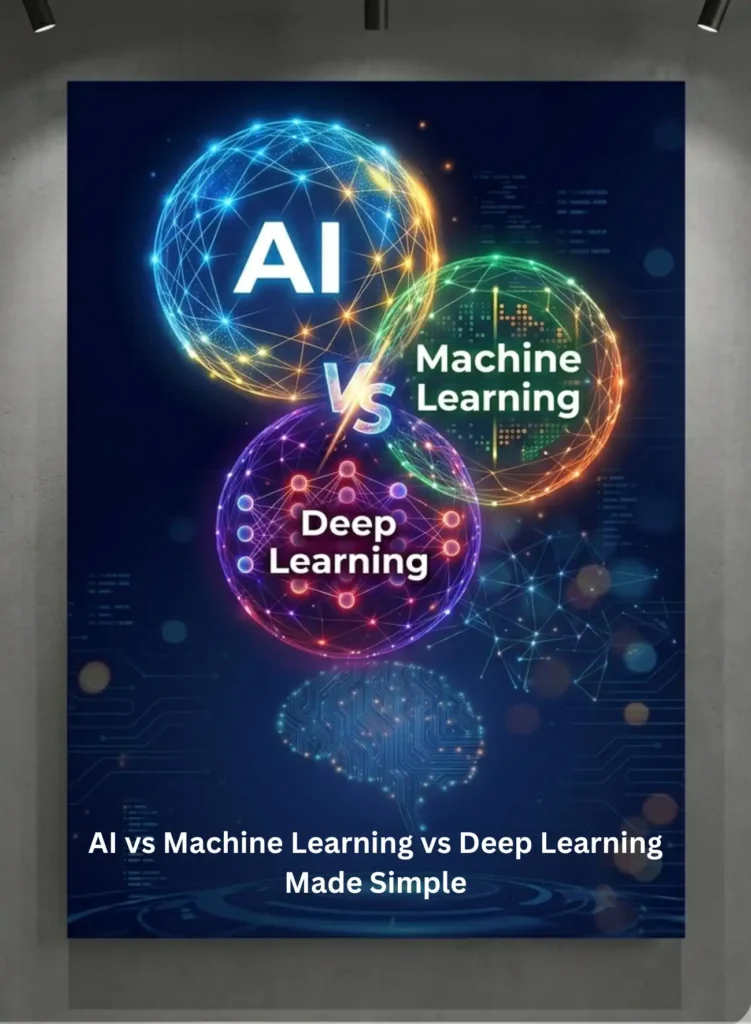
AI vs Machine Learning vs Deep Learning lets begin understading
When I first started exploring AI, I realized something most articles throw definitions at you right away. But in my 2 decades in IT, I’ve learned that definitions don’t stick — stories do. What most articles miss is the real-world context of how AI, Machine Learning, and Deep Learning actually show up in projects.
From my experience, whether I was working on Oracle systems, legacy Java projects, or experimenting with GitHub Copilot, the confusion was always the same: “Is this AI? Or is it Machine Learning? Or is it Deep Learning?”
This blog is my attempt to make it simple. Not by giving textbook answers, but by sharing insights from projects, analogies from everyday life, and lessons learned the hard way. If you’ve ever wondered about the difference between AI and Machine Learning, or AI vs ML vs DL, you’re in the right place.
What you will Learn in this Guide
Why This Confusion Exists in the IT Industry
From my experience, the confusion starts at the leadership level.
When I was recently managing a legacy Java Struts project integrated with AWS and Kafka messaging, the client said:
“We want AI integrated.”
When we probed further, they actually needed predictive analytics — which is Machine Learning.
This reminds me of the early days when everything database-related was called “Oracle” even if it was just SQL scripting. Similarly, today everything intelligent is called AI.
What most articles miss is this:
AI is the UMBRELLA. Machine Learning is a METHOD. Deep Learning is a SPECILIZAED SUBSET
But let’s not jump into definitions. Let’s understand this practically.
The Real-World Hierarchy: AI vs. ML vs. DL
This reminds me of when we first transitioned from monolithic systems to microservices. People used the terms interchangeably until they realized the underlying plumbing was completely different.
In the simplest terms, think of it like a nesting doll:
- Artificial Intelligence (AI) is the outer doll—it’s the broad vision of making a machine “smart.”
- Machine Learning (ML) is the doll inside—it’s the specific method of using data to train that smartness.
- Deep Learning (DL) is the smallest, most complex doll—it’s a specialized version of ML that mimics the human brain’s neural networks.
AI: The Big Umbrella (It’s Not Always “Magic”)
When I started as a junior programmer, “AI” was often just a massive series of IF-THEN-ELSE statements. That’s what we call Symbolic AI or Rule-Based AI.
In Simple Words AI is any technique that enables computers to mimic human behavior. If a computer does something that usually requires a human brain—like planning a route or playing chess—it’s AI.
Why This Matters for Your Projects
In my current role as a Project Manager, I see teams trying to “AI-enable” everything. But sometimes, a solid Oracle PL/SQL trigger or a well-documented business rule in a Java backend is all you need. You don’t need a neural network to tell a user their password is too short.
People Also Ask: Is ChatGPT AI or Machine Learning?
Answer: It’s both. ChatGPT is a generative AI application built using Deep Learning (a subset of Machine Learning). It’s the “Deep” part that allows it to understand context and nuance.
AI vs Machine Learning vs Deep Learning — The Big Picture
Imagine a hierarchy:
• Artificial Intelligence (AI) – The broad goal
• Machine Learning (ML) – One approach to achieve AI
• Deep Learning (DL) – A specialized method within ML
If AI is the dream of building intelligent systems, ML is the strategy, and DL is the advanced weapon.
From my experience in enterprise IT, understanding this hierarchy changes how projects are scoped and funded.
What Is Artificial Intelligence (AI) in Practical Terms
Artificial Intelligence is about making machines behave in ways we call “intelligent.”
Not necessarily self-aware. Not necessarily robots.
From my experience working across media, retail, telecom, and pharma domains, AI in enterprises usually means:
• Rule-based automation
• Decision systems
• Chatbots
• Fraud detection
• Recommendation engines
In Simple Words
AI is the broad idea of making computers think or act intelligently.
It doesn’t always require machine learning.
For example:
A rule-based insurance approval system built using predefined logic is AI — even if there is no learning involved.
This is something many professionals overlook.
People Also Ask:
Is AI only about robots?
Answer: No. In enterprise IT, AI mostly refers to intelligent decision-making software — not humanoid robots.
What Is Machine Learning (ML) — Explained from Real Projects
Machine Learning is when systems learn from data instead of being explicitly programmed.
This reminds me of a retail analytics project where instead of writing fixed discount rules, we fed historical sales data into a predictive model.
The model started identifying buying patterns better than our manual rule engine.
That was Machine Learning.
In Simple Words
Machine Learning allows systems to improve automatically using data.
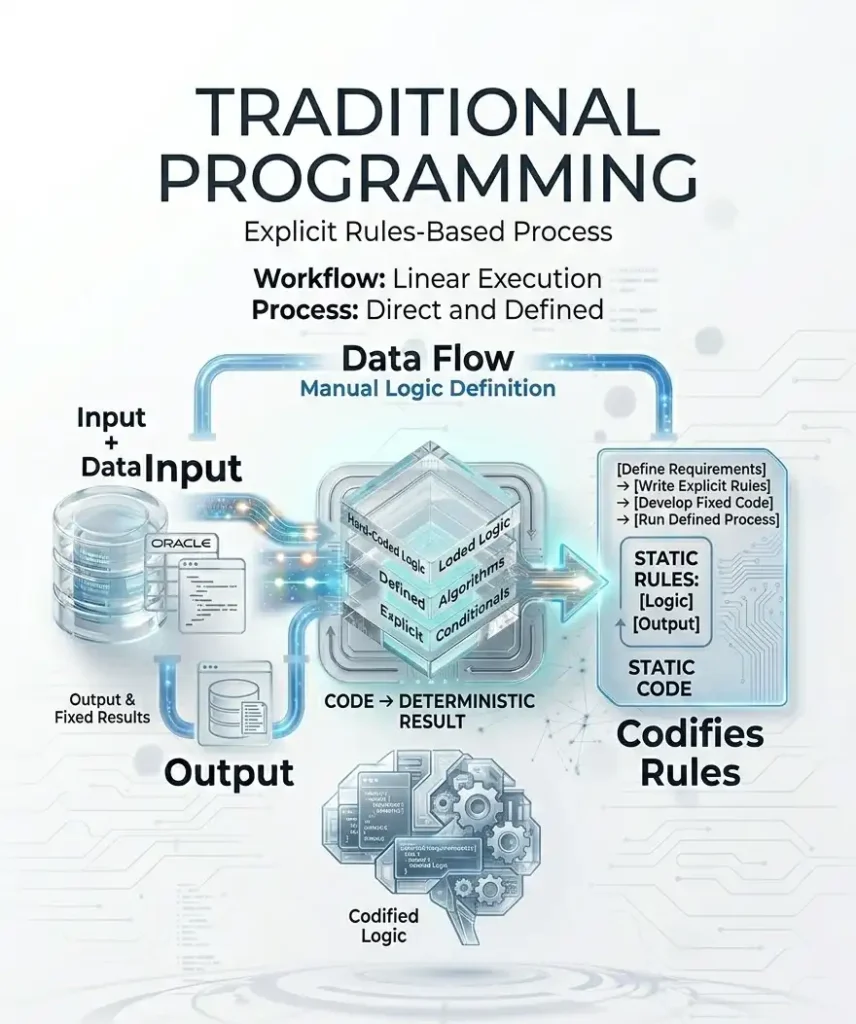
Unlike traditional programming:
Traditional Programming
Input + Rules → Output
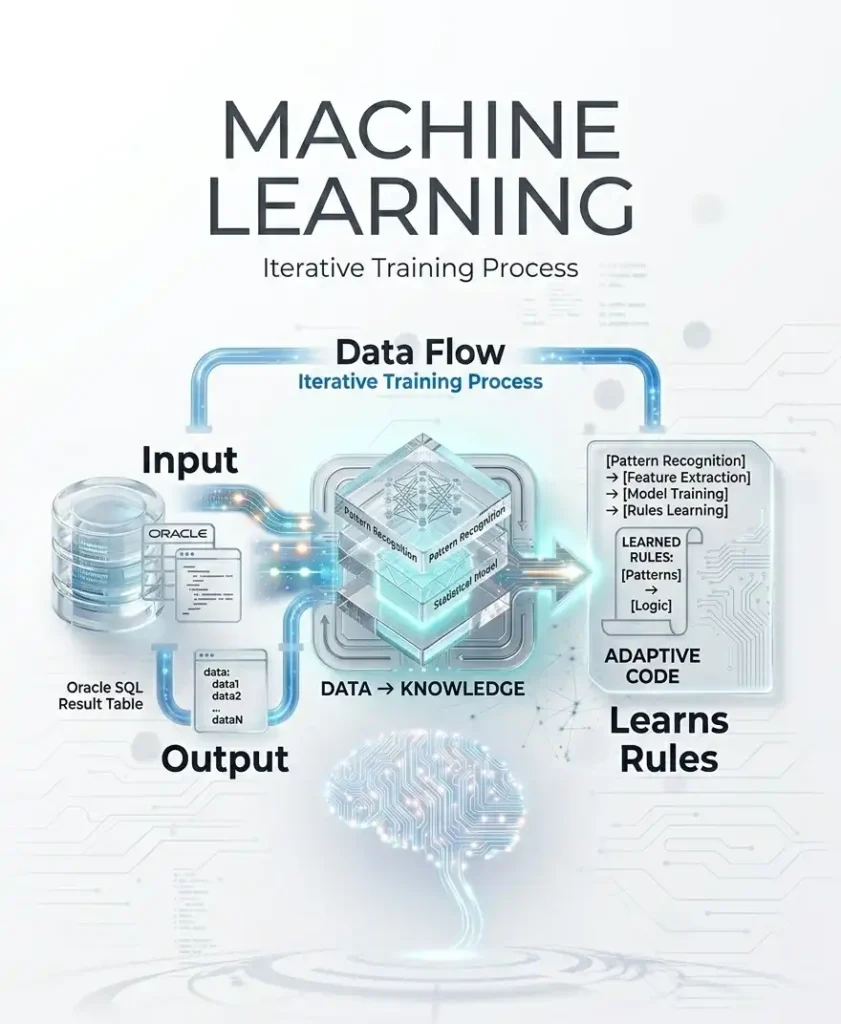
Machine Learning
Input + Output → Learns Rules
From my experience,
ML works best when:
• You have large structured datasets
• Patterns are too complex for manual rules
• Predictions improve with more data
People Also Ask:
What is the difference between AI and machine learning?
AI is the broader concept of intelligent systems. Machine Learning is a method within AI where systems learn from data instead of being manually programmed.
Machine Learning: Why It’s the Workhorse of Modern IT
If AI is the “what,” Machine Learning is the “how.”
In my 20 years, the biggest shift I’ve seen is moving from explicit programming (telling the computer exactly what to do) to probabilistic programming (showing the computer data and letting it figure out the patterns).
From My Experience
I once worked on a project for a large Retail Chain. We had millions of transaction records in a SQL Server. Traditionally, we’d write complex queries to find “loyal customers.” With Machine Learning, we fed that data into a clustering algorithm. The “ML” found patterns we hadn’t even thought of—like people who buy certain types of media and entertainment items on Tuesday nights also being likely to buy organic snacks.
The Three Flavors of ML
- Supervised Learning: You give the machine labeled data (e.g., “This is a fraudulent transaction,” “This is a clean one”).
- Unsupervised Learning: You give it raw data and say, “Find something interesting here.”
- Reinforcement Learning: The machine learns by trial and error (think of a robot learning to walk or an AI learning to play a video game).
What most articles miss: ML is only as good as your data. In my experience with Pharma and Telecom clients, 80% of an ML project is actually “Data Cleaning” in the Oracle or MySQL backend before the “Learning” even starts.
What Is Deep Learning (DL) — And Why It Feels “Magical”
Deep Learning is a subset of Machine Learning inspired by neural networks.
Now here is where things get interesting.
While working on emerging AI integrations and exploring tools like GitHub Copilot and large language models (LLM), I realized:
Deep Learning thrives on massive data and computing power.
It uses multi-layer neural networks to identify complex patterns — especially in:
• Images
• Speech
• Natural language
• Video
In Simple Words
Deep Learning is advanced machine learning using neural networks with many layers.
From my experience, DL becomes powerful when:
• Data is unstructured
• Traditional ML struggles
• Scale is massive
People Also Ask:
Is deep learning better than machine learning?
Not always. Deep learning works better for complex tasks like image or speech recognition. For structured business data, traditional machine learning is often more efficient and cost-effective.
Deep Learning: When to Bring Out the Big Guns (Neural Networks)
Now we get to the “Deep” part. If you’re working with Angular frontends and Kafka messaging tools to process massive amounts of unstructured data—like images, voice, or complex text—you’re likely in the territory of Deep Learning.
Deep Learning uses Artificial Neural Networks (ANNs).
In Simple Words
Deep Learning is Machine Learning on steroids. It doesn’t need a human to tell it which “features” are important. If you show an ML model 10,000 pictures of cars, you might have to tell it to look for “wheels” and “windows.” A Deep Learning model figures that out itself through its multiple layers.
Deep Learning in the Real World: A Media & Entertainment Example
Working with media clients, I’ve seen DL used for automated video tagging. Instead of a human watching hours of footage to tag “action scenes,” a Deep Learning model analyzes the pixels, identifies the movement, and tags it automatically with 98% accuracy.
Difference Between AI vs Machine Learning vs Deep Learning
| Aspect | AI | Machine Learning | Deep Learning |
|---|---|---|---|
| Scope | Broad concept | Subset of AI | Subset of ML |
| Learning | May or may not learn | Learns from data | Learns using neural networks |
| Data Need | Moderate | High | Very High |
| Compute | Low to Moderate | Moderate | High |
| Examples | Chatbots, Rule Engines | Sales Prediction | Image Recognition |
The Technical Breakdown
| Feature | Artificial Intelligence (AI) | Machine Learning (ML) | Deep Learning (DL) |
| Concept | The broad science of mimicking human intelligence. | A subset of AI that learns from data without being explicitly programmed. | A subset of ML that uses multi-layered neural networks. |
| Data Requirement | Can be small (rule-based). | Medium to Large (structured data). | Massive (unstructured data like images/audio). |
| Hardware | Standard CPUs. | Standard CPUs/Memory. | High-performance GPUs. |
| Human Intervention | High (for rule-setting). | Medium (feature engineering). | Low (features are learned automatically). |
Machine Learning vs Deep Learning — What Really Changes
Now let’s address the next big confusion:
machine learning vs deep learning
From my experience:
Machine Learning
• Requires feature engineering
• Works well with structured data
• Less computationally expensiveDeep Learning
• Automatically extracts features
• Works well with unstructured data
• Requires high computing power (GPU/Cloud)
When I worked with AWS infrastructure integrations, we clearly saw the cost difference when experimenting with DL models.
Deep Learning is powerful — but expensive.
People Also Ask:
When should I use deep learning instead of machine learning?
Use deep learning when dealing with large unstructured datasets like images or voice. For smaller structured business datasets, machine learning is usually more practical and cost-efficient.
AI vs Machine Learning vs Deep Learning Explained Simply
In Simple Words
- AI (Artificial Intelligence): The big umbrella. Any system that mimics human intelligence — whether it’s rule-based or learning-based.
- Machine Learning: A subset of AI. Systems that learn from data instead of being explicitly programmed.
- Deep Learning: A subset of ML. Uses neural networks with many layers to handle complex tasks like image recognition or natural language processing.
From my experience
AI is like the “idea of intelligence,” ML is the “practice of learning,” and DL is the “specialized skill of deep pattern recognition.”
In Simple Words: Everyday Analogies
This reminds me of driving a car.
- AI is the concept of transportation — the idea that machines can move us.
- Machine Learning is like learning to drive — practicing, adjusting, and improving with experience.
- Deep Learning is like an advanced driver who can handle complex terrains, traffic patterns, and even self-driving scenarios.
From my experience, these analogies help clients understand why not every project needs Deep Learning. Sometimes, a simple ML model is enough.
From My Experience
In one pharma project, the team wanted Deep Learning for drug interaction predictions. But after analyzing the data, we realized a basic ML model gave faster, more reliable results. The lesson? Don’t chase buzzwords — chase solutions.
From My Experience: Real IT Project Insights
Over the years, I’ve seen firsthand how AI, ML, and DL play out in real projects. One example that stands out is a legacy Java project I worked on for a telecom client. The system was struggling to predict customer churn. Initially, the team thought we needed Deep Learning because it sounded cutting-edge. But after analyzing the data, we realized a simple ML model — logistic regression — was enough.
From My Experience Deep Learning is powerful, but it’s not always the right fit. It requires massive datasets, high computing power, and complex infrastructure. In contrast, Machine Learning models can be lighter, faster, and more practical for many enterprise projects.
This reminds me of a pharma project where the client wanted “AI” for drug interaction predictions. In reality, the solution was a well-trained ML model. The lesson? Don’t confuse sophistication with effectiveness.
What Most Articles Miss About AI vs ML vs DL
Most articles I’ve read on this topic jump straight into definitions. But what they miss is the context. From my experience, definitions alone don’t help when you’re in the middle of a project deadline.
What most articles miss is as i have iterated many times above in my explanations
- The hierarchy: AI is the umbrella, ML is the method, DL is the advanced technique.
- The practicality: Not every problem needs Deep Learning. Sometimes, a simple ML model is more efficient.
- The human factor: AI isn’t just about algorithms. It’s about how teams, clients, and stakeholders perceive it.
This reminds me of a retail project where the client kept calling a rule-based system “AI.” Technically, it wasn’t. But in their mind, anything automated was AI. That perception gap is what most articles fail to address.
Practical Applications Across Industries
From my experience, the real power of AI, ML, and DL lies in their applications. Let me share a few examples across industries I’ve worked in:
- Media & Entertainment: AI-driven recommendation engines. ML models predict what content users will enjoy. DL powers video recognition and tagging.
- Pharma: ML models for drug interaction predictions. DL for analyzing medical images.
- Retail: AI chatbots for customer service. ML for demand forecasting. DL for personalized product recommendations.
- Telecom: ML models for churn prediction. DL for network optimization and anomaly detection.
- Automobile: AI in self-driving cars. ML for predictive maintenance. DL for image recognition in autonomous navigation.
In Simple Words
AI is the big picture. ML is the practical tool. DL is the specialized skill. Together, they’re transforming industries.
From my experience
Across domains:Media & Entertainment
Recommendation engines → MLRetail
Demand forecasting → MLPharma
Predictive diagnostics → DLTelecom
Churn prediction → MLAutomobile
Image-based defect detection → DL
AI, ML, and DL are not buzzwords. They are tools — and choosing the right one matters.
Common Myths That Confuse Professionals
• AI and Machine Learning are the same
• Deep Learning replaces all ML
• More data always means better AI
• AI projects are plug-and-play
Reality is different.
AI success depends on data quality, governance, and realistic expectations.
Common Questions (FAQ)
What is AI vs Machine Learning vs Deep Learning?
AI is the broader goal of building intelligent systems. Machine learning is a subset of AI where systems learn from data. Deep learning is a further subset of machine learning that uses neural networks with multiple layers.
What is the main difference between AI and Machine Learning?
AI is the broad goal of creating machines that can simulate human intelligence. Machine Learning is a specific technique used to achieve AI by training algorithms on data so they can make predictions or decisions without being told exactly what to do for every scenario.
From my experience, AI is the broader concept of machines acting intelligently, while ML is the method of learning from data.
When should I use deep learning vs machine learning?
Use Machine Learning for structured data (like Excel sheets or SQL tables) and when you have a smaller dataset. Use Deep Learning when you are dealing with unstructured data (like photos, voice, or free-form text) and have the high-performance hardware (GPUs) to support it.
Can AI work without machine learning?
Yes. Early AI (often called “Expert Systems”) used hard-coded rules and logic (if-this-then-that). While limited, these systems are still “AI” because they simulate decision-making, even though they don’t “learn” or improve from new data on their own.
Do all projects need Deep Learning?
Not at all. Most enterprise projects I’ve worked on succeed with ML models. DL is best for complex, unstructured data.
Can AI exist without ML or DL? Absolutely. Rule-based systems are AI too. I’ve seen them used effectively in retail and telecom projects.
What is the difference between AI and machine learning?
AI is the umbrella concept of intelligent behavior in machines. Machine learning is a technique within AI that allows systems to improve through data rather than explicit programming.
Is Deep Learning part of AI?
Yes. Deep learning is a subset of machine learning, and machine learning is a subset of AI.
Is Deep Learning part of ML?
Yes. DL is a specialized branch of ML that uses neural networks with many layers.
Which is better: AI, ML, or DL?
None is inherently better. The right choice depends on the business problem, data availability, and computational resources.
Can small companies use AI?
Yes. Many AI applications today are accessible through cloud platforms, making them affordable and scalable even for small businesses.
Closing Notes
I can confidently say:
Understanding AI vs Machine Learning vs Deep Learning is no longer optional.It influences architecture, hiring, cost, and long-term scalability.From my experience, clarity at the beginning saves millions later.
AI is not about hype.
It is about alignment between technology and business goals and once you understand the difference between AI, ML, and DL — decisions become simpler.
Don’t get blinded by the hype. Understand that AI is your destination, Machine Learning is your engine, and Deep Learning is the high-octane fuel you use when the mountain gets really steep.
About the Author
I have spent over two decades in the IT industry — starting as a junior programmer and now working as a Senior Project Manager in a multinational organization.I have worked across domains including media, pharma, retail, telecom, and automobile, handling technologies ranging from Oracle PL/SQL to complex Java-based legacy systems integrated with AWS and Kafka.
From my experience, clarity in technology saves projects from confusion and failure. This blog is my attempt to share insights not just from textbooks, but from real-world projects where AI, ML, and DL make a difference.
This blog reflects practical industry exposure — not only theoretical definitions.
If you found this useful, stay tuned. I will continue sharing grounded, experience-driven insights on AI and enterprise technology.
Also visit my blog page on ” Know it all series for what is AI ” which covers detailed explanation of AI.