
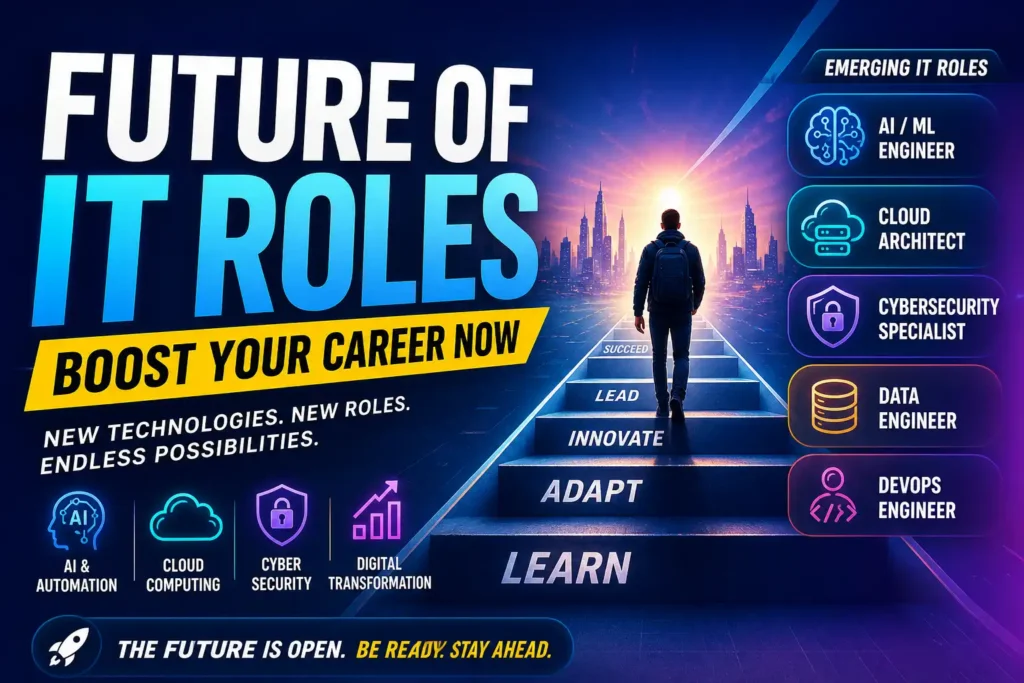
Future of IT Roles: Boost Your Career Now – Introduction
Something shifted in IT this year. And if you are working in technology, you have probably felt it too.
I have spent over two decades in enterprise IT. I have lived through ERP rollouts, cloud migrations, mobile-first transformations, and every major technology wave in between. None of them felt like this.
The future of IT roles is not arriving gradually. It is arriving all at once, across every layer of the technology stack, affecting developers, architects, analysts, and project managers simultaneously. AI is not coming for one job. It is reshaping the entire profession.
This article is not a prediction piece. It is a practitioner’s guide, written from real project experience across pharma, media, retail, telecom, and automotive industries. If you want to understand what is actually changing, which skills genuinely matter, and how to position your IT career for what comes next, you are in the right place.
Let us get into it.
Table of Contents
What Is Really Driving the Future of IT Roles
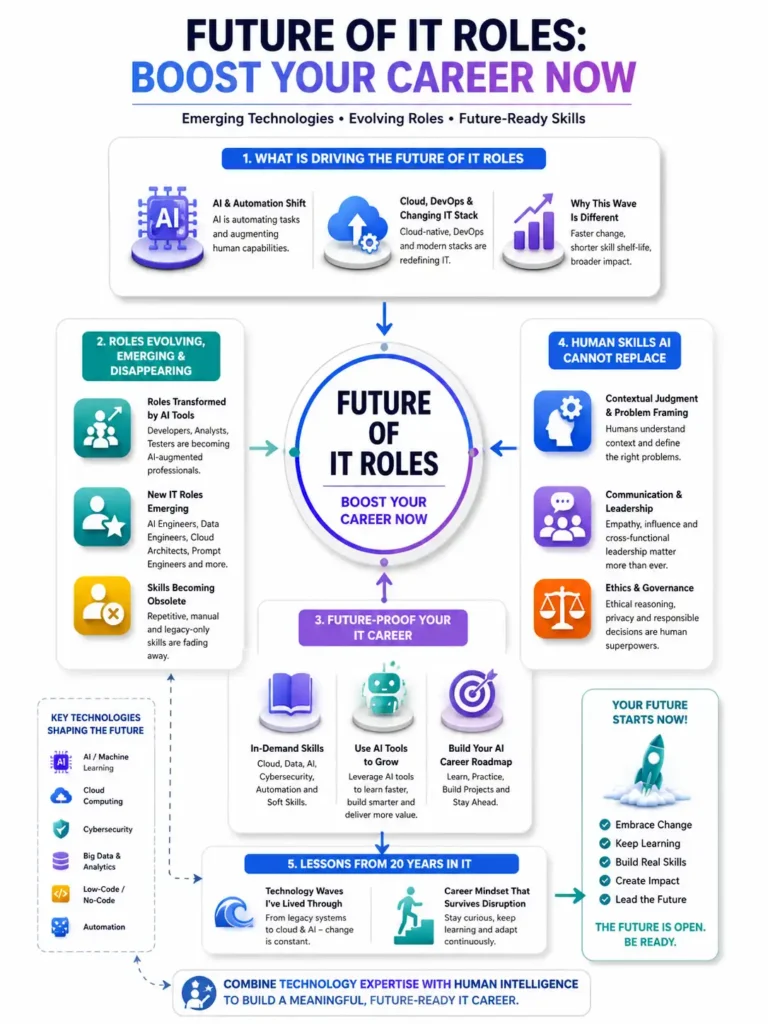
The AI and Automation Shift
Let me be direct. Artificial intelligence is not a background trend in IT anymore. It is sitting inside the tools your developers use every day, inside the platforms your infrastructure runs on, and inside the decisions your business stakeholders are making about technology investment.
From my experience working across multiple enterprise environments, I started noticing the shift not in boardroom presentations but in day-to-day project work. Developers on my team began using GitHub Copilot to accelerate code generation. Project managers started drafting requirement documents with ChatGPT. Infrastructure teams began exploring AI-assisted monitoring platforms that could correlate alerts and predict failure patterns before human analysts even flagged them.
This is not theoretical. This is already live in enterprise IT environments right now.
AI and automation are fundamentally changing the economics of IT work. Tasks that previously required three people and two weeks can now be supported by one person with the right AI tools in a fraction of the time. That changes headcount conversations. It changes hiring decisions. And it changes what skills enterprises are willing to pay for.
👉 From My Experience:
In one of my recent projects involving a complex legacy Java application with Kafka messaging and Angular frontend, we used AI-assisted code comprehension tools to onboard newer team members significantly faster than traditional code review and documentation methods. The ramp-up time reduction was real and measurable.
❓ People Also Ask
Question: How is AI changing IT jobs right now?
Answer: AI is automating repetitive IT tasks like code generation, testing, and incident monitoring. This is not eliminating IT jobs entirely, but it is fundamentally changing what those jobs require. Professionals who combine domain knowledge with AI tool proficiency are becoming significantly more productive and valuable than those working without AI support.
Cloud, DevOps, and the Changing IT Stack
Before AI became the dominant conversation, cloud and DevOps were already reshaping IT roles. What AI has done is accelerate and deepen that transformation.
From my experience working on AWS cloud infrastructure projects, the role of the traditional system administrator has already been largely absorbed by DevOps engineers and cloud architects. Manual provisioning, manual patching, and manual monitoring are progressively being replaced by infrastructure-as-code, CI/CD pipelines, and AI-assisted observability platforms.
What this means practically is that IT professionals who built their careers on managing physical infrastructure now need to extend their skills into cloud-native architectures, container orchestration, and increasingly, AI-integrated operations platforms.
The IT stack itself is changing shape. The boundary between development, operations, and data engineering is blurring. And AI is accelerating that boundary erosion faster than any previous technology shift I have worked through.
Why This Wave Is Different from Past Technology Changes
I want to spend a moment on this because I think it is important context for every IT professional reading this.
I started my career writing Oracle PL/SQL and Oracle Forms and Reports 6i. I moved through .NET, Java, SQL Server, MySQL, Power BI, Cognos, and Business Objects over the years. I have seen a lot of technology waves roll in.
Every previous wave had a clear adoption runway. ERP systems took years to implement. Cloud migration projects ran for eighteen months or more. Mobile-first strategies required entire new development pipelines built over time. You could plan, budget, pilot, and scale in sequence, with breathing room between each phase.
AI is different because it is arriving simultaneously across every layer of enterprise IT, with no waiting period. A junior developer and a CTO are both navigating it at exactly the same pace, at exactly the same moment. That has never happened in my career before. Not once.
📌 In Simple Words:
Previous technology waves gave IT teams years to adapt. AI is giving them months. The speed and breadth of this shift is genuinely unprecedented, and the IT professionals who recognise that early are the ones who will position themselves best for what comes next.
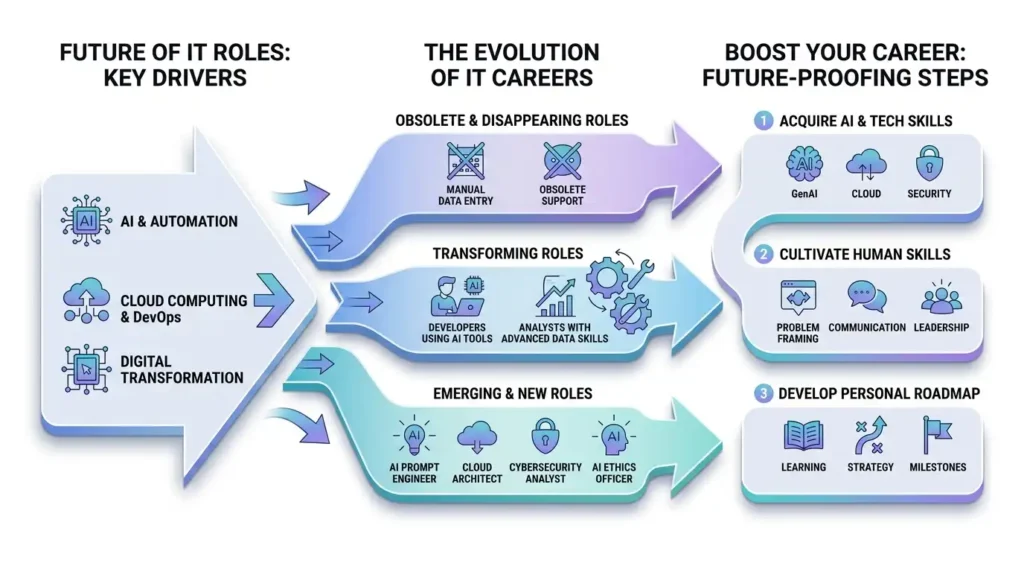
IT Roles That Are Evolving, Emerging, and Disappearing
Roles Being Transformed by AI Tools
Let us be specific. Certain IT roles are not disappearing, but they are being fundamentally redefined.
The software developer role is the clearest example. AI code generation tools like GitHub Copilot are not replacing developers. They are changing what a developer’s time is spent on. The boilerplate, the pattern-based code, the initial draft of a function, these are increasingly AI-assisted tasks. What remains distinctly human is the architectural thinking, the code review judgment, the contextual understanding of why a system is built the way it is, and the quality oversight of AI-generated output.
From my experience leading development teams, I have watched this transition firsthand. The developers who adapted quickly to working with AI tools became significantly more productive. Those who resisted the tools or dismissed them are working harder to keep pace.
The business analyst role is similarly transforming. Natural language querying tools and AI-powered BI platforms are enabling business stakeholders to access data insights without needing a BA to translate every request. The BA who adds value now is the one who understands the business problem deeply enough to frame the right AI query, validate the output, and translate the insight into strategic action.
New IT Roles Created by Digital Transformation
Every major technology shift creates new roles, and this one is no different.
Roles that barely existed five years ago are now in high demand:
- AI Integration Engineer: Responsible for connecting AI platforms and APIs into existing enterprise systems, a role that requires both AI knowledge and deep integration architecture experience.
- Prompt Engineer: Specialised in designing and optimising prompts for large language models to extract reliable, structured, and accurate outputs for enterprise use cases.
- AI Governance and Ethics Lead: Responsible for defining how AI is used within an organisation, what it can and cannot do, who reviews its outputs, and how compliance is maintained. This role is particularly critical in pharma and financial services.
- ML Ops Engineer: Focused on the operational deployment, monitoring, and maintenance of machine learning models in production environments.
- Data Quality and Governance Analyst: As AI models depend entirely on data quality, the role of ensuring clean, consistent, and governed enterprise data has become strategically important rather than a back-office function.
👉 From My Experience:
In my work across pharma clients, the AI Governance role became non-negotiable almost immediately. Pharma AI outputs must be explainable and auditable. Black-box decisions on drug safety data are simply not acceptable. This created demand for professionals who understand both the AI technology and the regulatory compliance framework simultaneously.
Skills Profiles That Are Becoming Obsolete
This is the part of the conversation that makes people uncomfortable. But I think honesty here is more valuable than comfort.
Skills that are losing strategic value in enterprise IT:
- Manual, repetitive coding tasks that can be AI-generated
- Traditional report building using legacy BI tools without AI integration
- Infrastructure management based purely on manual provisioning and monitoring
- Waterfall project management applied rigidly to fast-moving AI implementations
- Generic technical skills without domain context or business understanding
The common thread is not that technical skills are losing value. It is that technical skills without adaptability, business context, and AI tool fluency are losing value. The profile that enterprises are increasingly hiring for is someone who combines domain experience with the ability to work alongside AI effectively.
❓ People Also Ask Question:
Which IT roles are most at risk from AI automation? Answer: Roles most at risk are those built primarily on repetitive, pattern-based tasks: basic code generation, routine data entry, manual test execution, and standard report building. However, even these roles are not disappearing entirely. They are evolving to require AI tool proficiency and higher-order judgment skills alongside the core technical competency.
How to Future-Proof Your IT Career Right Now
The Skills Every IT Professional Needs in the AI Era
I get asked this question constantly, both by team members and by peers in the industry. What skills should an IT professional be building right now?
Here is my honest answer, drawn from both personal experience and what I am observing in enterprise hiring decisions:
AI tool proficiency is now a baseline expectation, not a differentiator. If you are not using AI tools in your daily work, you are already operating at a disadvantage relative to peers who are. Start with the tools most relevant to your role: GitHub Copilot for developers, Microsoft Copilot for productivity-focused roles, ChatGPT for documentation and communication, and AI-assisted platforms within your specific technical domain.
Data literacy is critical across all IT roles. As AI becomes embedded in enterprise decision-making, understanding how data flows, how data quality affects AI outputs, and how to interpret AI-generated insights is essential regardless of whether your primary role is technical or managerial.
Prompt engineering is a practical skill worth investing in. It sounds simple, and the concept is. Communicating clearly with AI tools to get reliable, structured, and useful outputs is a learnable skill that pays dividends immediately in productivity.
Cloud architecture fundamentals matter across all roles. Whether you are a developer, analyst, or project manager, understanding how cloud infrastructure works, how services connect, and what the cost and security implications of design decisions are will make you a stronger contributor in any enterprise AI project.
📌 In Simple Words:
Future-proofing your IT career is not about learning every new tool. It is about building three things: AI tool fluency, stronger business context awareness, and the judgment to know when to trust AI output and when to question it. Those three things together are what enterprises will pay a premium for.
How to Use AI Tools to Accelerate Your Own Growth
One of the most powerful things I have realised about AI tools is that they can accelerate your own professional development, not just your daily task output.
Here is how I have personally used AI tools to grow:
I use ChatGPT to get rapid context on unfamiliar technology domains before client meetings. Before stepping into a conversation about a technology I am less familiar with, I can ask ChatGPT to explain it clearly, identify the key considerations, and flag the common misconceptions. This is the equivalent of a rapid briefing from a very knowledgeable colleague.
I use GitHub Copilot not just to generate code, but to understand code patterns in languages where I am not primary-skilled. In my current project, which involves a complex legacy Java Struts application, Copilot has helped me quickly understand code structures that would have taken significantly longer to review manually.
I use generative AI tools to create structured first drafts of documentation, project summaries, and stakeholder communications, which I then review, refine, and personalise. This has meaningfully changed how much time I spend on communication tasks versus delivery work.
👉 From My Experience:
The professionals on my team who have improved fastest in the last year are the ones who treat AI tools not as shortcuts but as learning accelerators. They ask the AI to explain what it generated, not just to generate it. That habit alone is building their technical depth faster than traditional self-study would.
Building a Personal AI Roadmap for Career Advancement
A career roadmap in the AI era does not look like a linear progression through technical certifications anymore. It looks more like a continuous learning portfolio.
Here is a practical framework I would suggest for any IT professional:
Start with one AI tool in your current role. Do not try to learn everything at once. Pick the tool most relevant to what you do today and commit to using it seriously for sixty to ninety days. Build proficiency and observe where it adds value and where it does not.
Add a data literacy layer. Take a structured course in data fundamentals if you do not already have that grounding. Understanding how data is structured, cleaned, and governed will serve you regardless of where AI takes your role.
Seek out an AI-adjacent project at work. Volunteer to be part of an AI pilot, a data governance initiative, or an automation project within your organisation. Hands-on enterprise experience with AI is significantly more valuable than certification alone.
Build your perspective and voice. Write about what you are learning. Share your experience in team meetings. Becoming the person in your organisation who articulates the real-world application of AI tools builds both credibility and visibility.
The Human Skills AI Cannot Replace in IT
Contextual Judgment and Problem Framing
This is the skill I value most after twenty-plus years in IT, and it is the one AI cannot replicate.
Contextual judgment is the ability to understand a problem fully before jumping to a solution. It is knowing that the performance issue a client is reporting is actually a data modelling problem underneath, not a query optimisation issue. It is recognising that the project delay is a stakeholder alignment problem, not a resource shortage.
AI can analyse data and surface patterns at extraordinary speed. But it operates on the information it is given. The ability to know what information matters, what questions to ask first, and how the technical problem connects to the business problem: that is a human skill built over years of real project experience.
👉 From My Experience:
This reminds me of a project where the client presented a data quality problem that turned out, on investigation, to be a process problem at the source. No AI tool would have surfaced that without a human who understood the full operational context asking the right questions first.
Stakeholder Communication and Cross-Functional Leadership
Enterprise IT does not operate in a vacuum. Successful delivery requires navigating organisational dynamics, managing conflicting priorities, building trust across business and technical teams, and communicating complex technical realities in language that non-technical stakeholders can act on.
These are deeply human skills. They require empathy, patience, political awareness, and the ability to read a room. They are built through lived experience, through difficult conversations, through failed projects and successful recoveries.
AI can draft a stakeholder update. It cannot read the tension in a steering committee meeting, recognise that a key sponsor is losing confidence, and adjust its communication strategy in real time. That is a project manager’s job. It will remain a project manager’s job.
Ethical Reasoning and Governance in Technology Decisions
As AI becomes embedded in enterprise decision-making, the ability to reason about the ethical implications of technology choices is becoming a critical IT professional skill, not a soft skill reserved for leadership.
Questions like: Should this decision be automated? Who is accountable when an AI recommendation is wrong? How do we ensure this model does not produce biased outputs in a compliance-sensitive context? These are not purely technical questions. They require judgment, values, and an understanding of organisational and societal context that no AI model currently possesses.
From my experience in pharma projects, this is particularly acute. The stakes of an incorrect AI-assisted recommendation in a clinical or regulatory context are simply too high to leave without robust human governance frameworks. The IT professionals who understand both the technology and the governance implications will be invaluable in these environments.
❓ People Also Ask Question:
What human skills will remain valuable in IT as AI advances? Answer: The human skills most resistant to AI automation in IT are contextual judgment, stakeholder communication, ethical reasoning, and complex problem framing. These capabilities require lived experience, emotional intelligence, and organisational awareness that AI tools can support but cannot replicate. They will remain in high demand as AI scales across enterprise IT.
Lessons from 20 Years in IT – What Really Matters
Technology Waves I Have Lived Through and What They Taught Me
I want to share something that I think gets lost in the urgency of every new technology conversation.
Every wave I have lived through in IT promised to change everything. And every wave did change things, significantly in some areas, less than expected in others. The ERP rollouts of the early 2000s transformed business operations but required far more change management than the vendors suggested. Cloud migration delivered genuine flexibility but created new complexity around security, governance, and cost management. Mobile-first strategies opened new channels but required years of pipeline investment before they paid off.
AI will follow a similar pattern. Some of the current predictions will prove correct. Others will be overstated. The specific shape of the change will be different from what anyone is projecting today. What will not change is the pattern: successful IT professionals will be the ones who engaged with the technology early, built practical experience alongside the hype, and maintained their focus on the underlying business problems rather than the technology itself.
👉 From My Experience:
The one constant across every technology wave I have navigated is this: the professionals who thrive are not the ones who knew the most about the new technology first. They are the ones who knew how to apply it to a real business problem with discipline, governance, and stakeholder partnership. That has never changed. It will not change now.
The Career Mindset That Survives Every Disruption
After two decades in enterprise IT, the career mindset I would pass on to every IT professional navigating the future of IT roles is this:
Stay curious and stay current, but stay grounded. Curiosity drives you to understand new tools and technologies before you are forced to. Being current keeps you relevant in hiring and project conversations. But staying grounded means never losing sight of the business problems you are solving, the people you are working with, and the quality standards that actually matter in enterprise delivery.
Invest in relationships. Technology changes. Relationships compound. The professional network you build over your career, the trust you establish with clients and colleagues, the reputation you earn through reliable delivery: these assets appreciate over time in ways that technical skills alone cannot match.
Own your learning. Do not wait for your organisation to send you on an AI training course. Use the tools. Build your own perspective from direct experience. The IT professionals who are best positioned for what comes next are the ones who are already using GitHub Copilot, ChatGPT, and Microsoft Copilot in their daily work and forming real opinions about where they add value.
📌 In Simple Words:
The future of IT roles belongs to professionals who bring something AI cannot: years of contextual experience, real human judgment, and the ability to take responsibility for outcomes in complex, messy, high-stakes enterprise environments. That combination is irreplaceable. Build it deliberately.
Conclusion
The future of IT roles is not a distant scenario to prepare for. It is the present reality to engage with right now.
AI, automation, cloud-native architectures, and digital transformation are reshaping what enterprise IT looks like from the ground up. Some roles are evolving. New roles are emerging. And the skills that will define the most valuable IT professionals of the next decade are already becoming clear.
The IT professionals who will lead through this shift are not necessarily the most technically advanced. They are the ones who combine deep domain experience with genuine AI tool fluency, strong human judgment, and the governance awareness to apply technology responsibly in complex enterprise environments.
That combination is what I have spent twenty years building. And I can tell you from experience that it has never been more relevant than it is right now.
If you have read this far, here is your one action for today: pick one AI tool, commit to using it seriously in your actual work this week, not in a demo, not in a tutorial, but on a real task with a real outcome. Build your perspective from experience. That is where real career growth starts.
FAQ
❓ What does the future of IT roles look like in the age of AI?
The future of IT roles involves a shift from task-based execution to judgment-based oversight. AI tools are handling more repetitive, pattern-based work, while IT professionals are increasingly valued for contextual thinking, governance, stakeholder communication, and the ability to apply AI outputs responsibly within complex enterprise environments.
❓ Which IT skills are most in demand right now?
The highest-demand IT skills currently include AI tool proficiency, cloud architecture knowledge, data literacy, prompt engineering, and AI governance understanding. Soft skills including stakeholder communication and contextual judgment are equally critical. Professionals who combine technical depth with business context awareness are particularly sought after.
❓ Is AI replacing IT jobs or changing them?
AI is primarily changing IT jobs rather than eliminating them. Roles are evolving to require AI tool fluency alongside existing technical expertise. New roles focused on AI integration, governance, and operations are emerging. The professionals most at risk are those relying exclusively on repetitive tasks without adapting to work alongside AI tools.
❓ How long does it take to future-proof an IT career?
There is no fixed timeline, but meaningful progress is achievable within three to six months of deliberate effort. Start with one AI tool relevant to your current role, build data literacy foundations, and seek out an AI-adjacent project at work. Consistent, applied learning over six to twelve months creates a measurable shift in both capability and professional positioning.
❓ Can experienced IT professionals compete with AI-native younger professionals?
Absolutely. Experienced IT professionals bring something AI-native practitioners are still building: contextual judgment, enterprise delivery experience, stakeholder relationships, and the ability to navigate complex organisational environments. Combined with AI tool proficiency, that experience is a significant competitive advantage, not a liability.
About the Author:
I am a seasoned IT professional with over twenty years of experience.
Currently, I lead delivery on a complex legacy Java modernisation project involving Java Struts, Angular, AWS cloud infrastructure, and Kafka messaging systems. I have complemented this technical foundation with formal learning in GitHub Copilot, ChatGPT prompting, Microsoft Copilot, and AI agent architectures.
I write to share practical, experience-based perspectives on technology that work in the real world.In recent years, I’ve focused deeply on generative AI, ChatGPT prompting, and AI productivity tools. I’m passionate about simplifying complex technology concepts and helping professionals navigate the evolving future of IT roles with confidence.
To know more about “Role of Agents in Artificial Intellegence” read my blog post link below
10 Powerful AI Tools That Will Boost Your Productivity