Microsoft AI Models
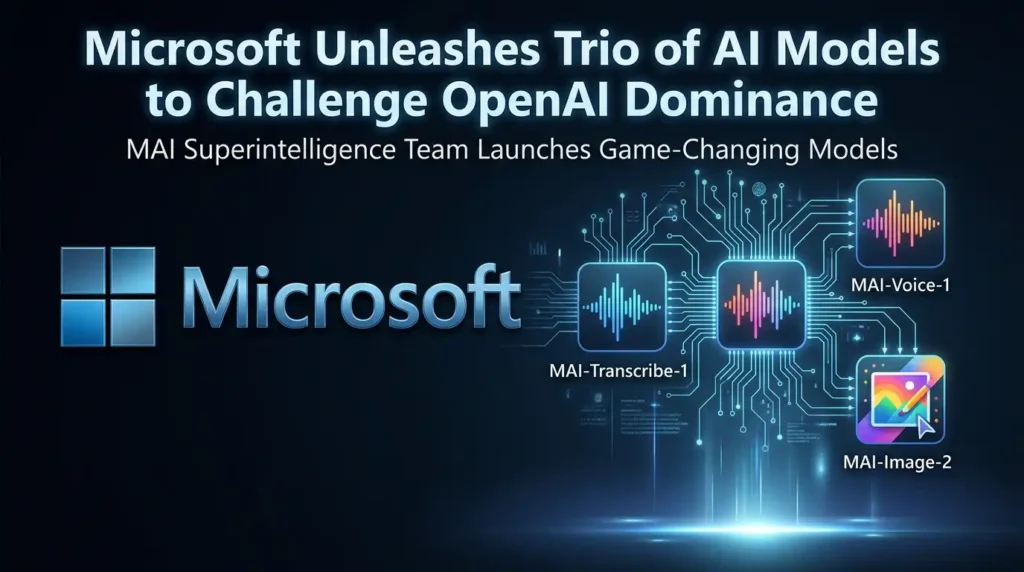
Microsoft’s AI Superintelligence team has launched three groundbreaking multimodal foundational models, intensifying competition with OpenAI and Google while bolstering its own AI infrastructure. The April 2, 2026, release of MAI-Transcribe-1, MAI-Voice-1, and MAI-Image-2 marks a pivotal step in Microsoft’s push for self-sufficiency in AI development, backed by a $13.5 billion investment. These models, now accessible via Microsoft Foundry and the US-only MAI Playground, promise developers faster, cheaper tools for speech, voice, and image processing.
Table of Contents
MAI Superintelligence Team’s Origins and Vision
The Microsoft AI (MAI) Superintelligence team, formed in November 2025 and led by Mustafa Suleyman former co-founder of DeepMind focuses on advancing AI agents, medical diagnosis, and energy-efficient computing. Suleyman, who joined Microsoft after his stint at DeepMind and Inflection AI, oversees efforts to build foundational models that rival industry leaders while preserving key partnerships like those with OpenAI.
This initiative reflects Microsoft’s strategic pivot toward in-house innovation, reducing reliance on external providers. As part of a broader $13.5 billion commitment to AI infrastructure, the team aims to deliver models optimized for real-world applications in science, healthcare, and beyond. “We’re building the future of AI with optionality—our models complement partners like OpenAI while giving developers cutting-edge tools,” a Microsoft spokesperson stated in the announcement. The team’s formation underscores Microsoft’s ambition to lead in the race toward artificial general intelligence, or superintelligence
Spotlight on the New Models: Capabilities and Benchmarks
At the heart of the launch are three multimodal models tailored for efficiency and performance. MAI-Transcribe-1 excels in speech-to-text transcription across 25 languages, delivering 2.5 times faster processing and top accuracy on the FLEURS benchmark, all at 50% lower GPU costs compared to prior Azure services. This makes it ideal for enterprise applications like real-time translation and accessibility tools.
MAI-Voice-1 generates 60 seconds of expressive, natural-sounding audio in just one second using a single GPU, enabling rapid prototyping for voice assistants, audiobooks, and personalized content creation. Complementing these is MAI-Image-2, which debuted on March 19, 2026, and ranks in the top three on arena.ai leaderboards for image generation quality. Unlike competitors, these models emphasize multimodal integration—handling text, voice, and images seamlessly—for agentic workflows.
Mustafa Suleyman highlighted the technical leap: “These models represent a new era of accessible superintelligence, where speed and cost barriers fall away for builders everywhere.” Developers can now experiment via Microsoft Foundry, a platform for fine-tuning and deployment, or the MAI Playground for interactive testing (currently US-only). Early benchmarks show MAI-Transcribe-1 outperforming rivals in multilingual scenarios, positioning Microsoft strongly in global markets.
Strategic Positioning Amid Partnerships and Rivalry
Microsoft’s move arrives amid heightened scrutiny of its OpenAI ties, clarifying that these launches enhance rather than replace collaborative efforts. While OpenAI pursues its own “ChatGPT Super App” a desktop unification of chat, coding, search, and browser tools Microsoft focuses on modular, developer-centric models. The MAI suite competes directly with OpenAI’s GPT series and Google’s offerings by prioritizing cost-efficiency and multimodal prowess.
This self-sufficiency drive builds on Microsoft’s Azure infrastructure, which powers much of the AI ecosystem. The April 2 announcement, covered extensively by TechCrunch and LinkedIn posts from Microsoft execs, emphasizes integration with existing tools like Copilot. “By offering these world-class models, we’re empowering enterprises to innovate without vendor lock-in,” noted a post from Microsoft AI leadership. The timing aligns with broader 2026 roadmaps, including agentic AI for automation and scientific discovery.
Roadmap Ahead: Agents, Healthcare, and Beyond
Looking forward, Microsoft plans additional models throughout 2026 targeting AI agents, healthcare diagnostics, and quantum-enhanced computing. The MAI team’s early successes signal a robust pipeline, with expansions to global Playground access and deeper Azure integrations on the horizon. These developments come as Microsoft navigates regulatory landscapes and invests heavily in ethical AI frameworks.
For developers and enterprises, the implications are profound: lower barriers to advanced AI mean faster innovation in voice-enabled apps, precise transcriptions for compliance, and high-fidelity image tools for design workflows. As Suleyman envisions, this positions Microsoft not just as a partner, but as a frontrunner in democratizing superintelligent capabilities. Enterprises adopting these models today stand to gain a competitive edge in an AI-driven economy.
Disclosure Note: This article draws together details from public reports dated April 2026. All information comes from listed sources below; no independent interviews or data collection occurred. Draft refined by AI tools for clarity, with human oversight.
Sources:
- Economic Times TechMonk: “Microsoft AI Unveils Three New Multimodal Models” (Apr 2, 2026) https://techmonk.economictimes.indiatimes.com/news/ai/microsoft-ai-unveils-three-new-multimodal-models-for-text-voice-image-gene[techmonk.economictimes.indiatimes]
- TechCrunch: “Microsoft takes on AI rivals with three new foundational models” (Apr 2, 2026) https://techcrunch.com/2026/04/02/microsoft-takes-on-ai-rivals-with-three-new-foundational-models/[techcrunch]
- Microsoft LinkedIn Exec Post: MAI models announcement (Apr 1, 2026) https://www.linkedin.com/posts/dabelcher_today-were-announcing-3-new-world-class-activity-7445528996244684800-VxAm[linkedin]
- Microsoft Tech Community: “Introducing MAI-Transcribe-1…” (Apr 1, 2026) https://techcommunity.microsoft.com/blog/azure-ai-foundry-blog/introducing-mai-transcribe-1-mai-voice-1-and-mai-image-2-in-micro[techcommunity.microsoft]
- JustThink.ai: “Microsoft’s MAI Revolution” (Apr 1, 2026) https://www.justthink.ai/blog/microsofts-mai-revolution-3-new-models-to-topple-openai-and-google[justthink]
- Economic Times: Model launches details (Apr 2, 2026) [link to ][economictimes]
- Reddit r/deeplearning: Team formation (Nov 2025) https://www.reddit.com/r/deeplearning/comments/1ou73c5/microsoft_just_formed_a_superintelligence_team/[reddit]
- LinkedIn Pulse: Team under Suleyman (Nov 2025) https://www.linkedin.com/pulse/microsoft-launches-new-superintelligence-team-under-mustafa-simic-ggqsf[linkedin]
- YouTube: MAI-Image-2 overview (Mar 22, 2026) https://www.youtube.com/watch?v=8NPCg4qYMJA[youtube]
- Computerworld: OpenAI context (Mar 19, 2026) https://www.computerworld.com/article/4148228/openais-desktop-superapp-the-end-of-chatgpt-as-we-know-it.html[blog.mean]
To have more insights about AI visit How to Explain Artificial Intelligence? A Beginners Guide