
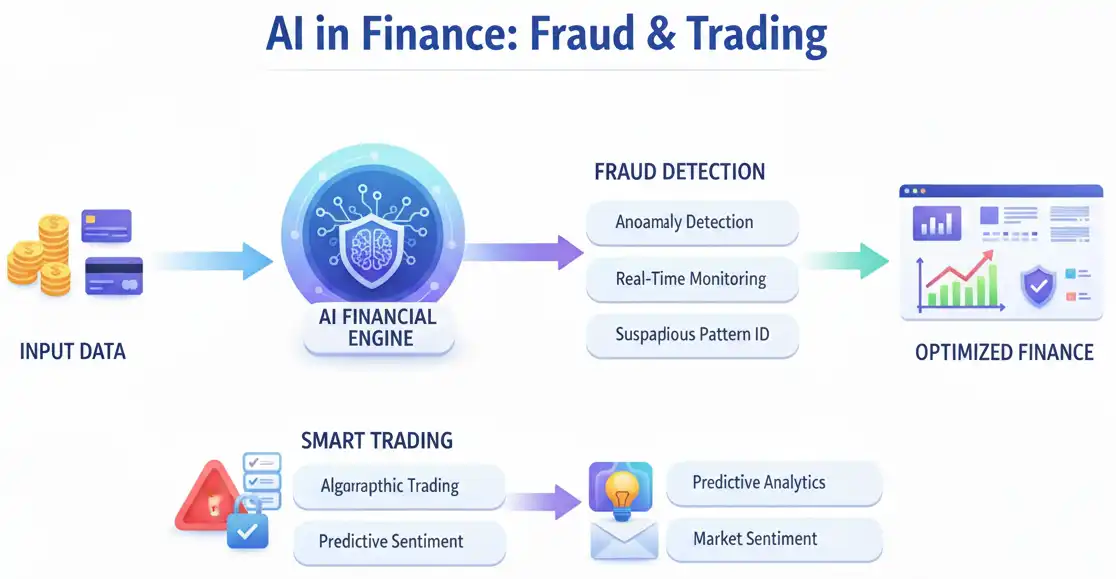
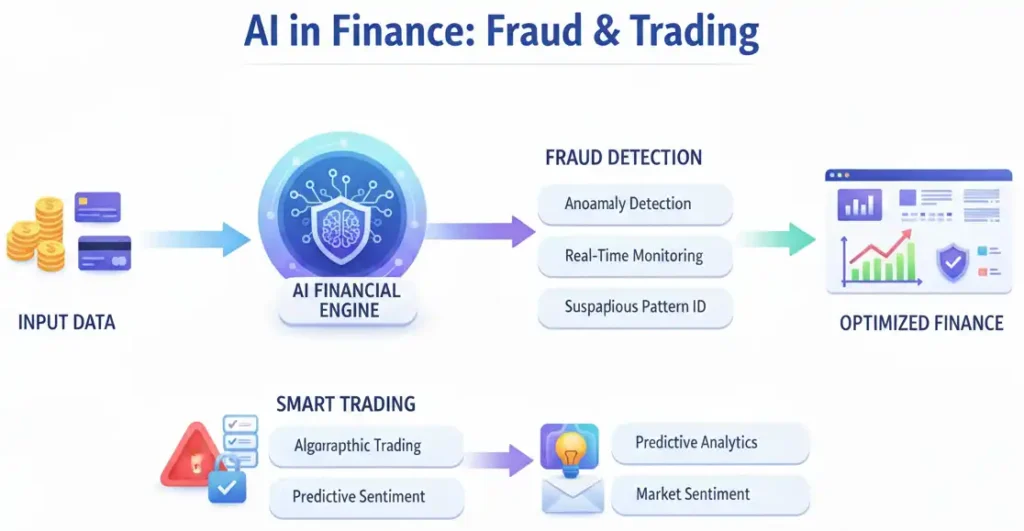
AI in Finance Fraud detection – Introduction
What if the system that approved your mortgage, flagged your stolen credit card, and executed a billion-dollar trade — all happened in the same second, without a single human involved?
That is not a sci-fi scenario. That is AI in finance fraud detection working right now, inside the institutions managing your money.
I have spent decades in enterprise IT. I have watched ERP rollouts, cloud migrations, and mobile-first revolutions come and go. But when I started seeing AI deployed in financial environments — not in demos, not in pilot decks, but in live production systems making real-time decisions on real money — I knew this was different.
Most people hear “AI in finance” and think of chatbots or robo-advisors. What they miss is the deeper, more consequential story: AI is quietly becoming the immune system of the global financial world, detecting fraud before humans can blink and executing trades with a precision no analyst can match.
In this article, I am going to walk you through exactly how that works — and what it means for the future of finance.
Table of Contents
AI in Finance Fraud Detection and Trading: What is it ?
When we talk about AI in finance fraud detection, we’re referring to systems that can analyze millions of transactions, detect anomalies, and even predict fraud before it happens.
👉But this is just one side of the story.
The same AI techniques are also used in trading—where machines analyze market data, news sentiment, and historical trends to make investment decisions.
How AI Differs from Traditional Financial Security Systems
Traditional financial security systems operated on rules. Hard-coded, manually maintained, committee-approved rules. If a transaction matched a known fraud pattern, it was flagged. If it did not match, it passed. The problem is that fraudsters do not follow rules. They evolve. They probe. They find the gap between rule 47 and rule 48 and walk right through it.
AI in finance fraud detection works differently. Instead of matching against a fixed rulebook, AI models learn from millions of historical transactions both legitimate and fraudulent and build a probabilistic understanding of what “normal” looks like. When something deviates from normal, even in a subtle and previously unseen way, the model raises a flag.
This shift from rule-based to learning-based detection is the foundational difference. And it changes everything.
❓ People Also Ask
How does AI differ from traditional fraud detection in banking?
Traditional systems use fixed rules to flag known fraud patterns. AI uses machine learning to learn what normal behavior looks like and detect deviations — including new, never-before-seen fraud methods. This makes AI significantly more adaptive and effective in rapidly evolving financial threat environments.
The Scale of Financial Fraud AI Is Designed to Combat
The numbers are staggering. Global payment card fraud alone runs into tens of billions of dollars annually. Identity theft, account takeover, synthetic identity fraud, insider trading — the financial system faces threats at a scale that simply cannot be managed by human analysts reviewing transactions one by one.
This reminds me of a scenario from one of my retail projects years ago. We were dealing with a high-volume e-commerce platform processing thousands of transactions per hour. The fraud team was manually reviewing flagged transactions — and drowning. The flag rate was high, the accuracy was poor, and genuine customers were being blocked while actual fraudsters were slipping through.
The problem was not effort. The problem was scale. Humans cannot process ten thousand transactions per minute. AI can.
When I look at modern financial institutions deploying AI in finance fraud detection, the scale of what is being monitored is extraordinary. Every card swipe, every wire transfer, every login attempt, every trading order — analyzed in real time, against a model trained on hundreds of millions of prior events, returning a risk score in milliseconds.
That is the scale AI was built for.
How AI Detects and Prevents Financial Fraud
Anomaly Detection and Real-Time Transaction Monitoring
The most widely deployed AI capability in financial fraud prevention is anomaly detection. The concept is elegant in its simplicity: build a model that deeply understands normal, and then flag everything that is not normal.
In practice, “normal” is complex. Your spending pattern is not the same as mine. A transaction that looks suspicious on my account — a large purchase in a foreign city at 2am — might be perfectly routine for a frequent business traveler. AI models are now sophisticated enough to build individual behavioral profiles for each account holder, not just apply population-level rules.
Real-time transaction monitoring takes this further. Modern AI systems do not just analyze a single transaction in isolation. They analyze sequences of transactions, the velocity of activity, the device being used, the geolocation, the time of day, the merchant category — all simultaneously, all in milliseconds, all against a learned model of what that specific account typically looks like.
Machine Learning Models That Identify Suspicious Patterns
The machine learning models deployed for financial fraud detection are not a single algorithm. In production enterprise environments, what you typically see is an ensemble — multiple models working in parallel, each specializing in different signal types, with a meta-model aggregating their outputs into a final risk score.
The most commonly deployed model types include:
- Supervised learning classifiers trained on labeled historical fraud data — these are strong at catching known fraud typologies
- Unsupervised anomaly detection models that flag unusual behavior without needing labeled examples — these catch novel fraud methods
- Graph neural networks that analyze the relationships between accounts, devices, and transactions to detect coordinated fraud rings
- Recurrent neural networks and transformer models that analyze sequences of events over time to detect gradual account takeover patterns
❓ People Also Ask
What machine learning models are used for fraud detection in banking?
Banks commonly use supervised classifiers for known fraud patterns, unsupervised models for novel threats, graph networks for fraud ring detection, and sequence models for account takeover detection. Most production systems use ensemble approaches — combining multiple models whose outputs are aggregated into a single risk score.
Case Studies — Banks Using AI to Stop Fraud Today
Several of the world’s largest financial institutions have publicly documented their AI fraud detection deployments, and the results are instructive.
HSBC partnered with an AI provider to deploy a network analytics system analyzing transaction relationships in real time. The system identified fraud rings and money laundering networks that were invisible to their previous rule-based system, improving detection rates significantly while reducing false positives — meaning fewer legitimate customers being incorrectly blocked.
PayPal has long been a leader in AI-powered fraud detection, processing hundreds of millions of transactions and using deep learning models to maintain fraud loss rates that are well below industry averages, a direct result of years of investment in machine learning infrastructure.
American Express has invested heavily in AI for fraud detection, using models that analyze hundreds of data points per transaction across its global network and demonstrating detection accuracy that would be operationally impossible with human review alone.
The consistent theme across all these deployments is the same: AI in finance fraud detection does not just improve detection rates. It improves them at a scale that fundamentally changes the economics of fraud prevention.
AI’s Powerful Role in Smart Trading
Algorithmic and High-Frequency Trading Explained
If AI in fraud detection is the immune system of finance, AI in trading is the nervous system processing signals, making decisions, and executing actions at a speed that the unaided human mind simply cannot match.
Algorithmic trading uses computer programs to execute trades based on predefined rules price thresholds, timing signals, volume conditions. This has existed for decades. What AI brings is something different: the ability to learn new trading signals from data, adapt strategies in response to market conditions, and operate across thousands of instruments simultaneously with a sophistication no rules-based algorithm can replicate.
High-frequency trading takes this to an extreme. HFT firms execute millions of trades per day, holding positions for milliseconds or microseconds, profiting from tiny price discrepancies that exist for fractions of a second. The competitive advantage in HFT is measured in nanoseconds of latency the time it takes for a signal to travel from a data feed to an executed order.
Predictive Analytics and Sentiment Analysis in Market Trading
Beyond execution speed, AI is transforming how trading decisions are made in the first place. Predictive analytics models analyze historical price data, macroeconomic indicators, earnings reports, and order flow patterns to generate probabilistic forecasts about future price movements.
Sentiment analysis adds another layer. Natural language processing models now scan news feeds, earnings call transcripts, regulatory filings, social media, and analyst reports in real time — extracting market-relevant signals from unstructured text faster than any human research team could process them.
This is not theoretical. Hedge funds including Two Sigma and Renaissance Technologies are well known for deploying quantitative and AI-driven trading strategies at scale. The use of NLP for earnings call sentiment analysis is now so widespread that many institutional traders consider it a standard part of their analytical toolkit.
Machine learning in financial trading is also being applied to portfolio optimization — moving beyond traditional mean-variance optimization to models that better capture the non-linear relationships between assets and that are more robust to the kind of market regime changes that crash classic models.
Risks and Limitations of AI-Driven Trading Systems
What most articles miss in the AI trading narrative is the risk side of the story. And as someone who has spent decades managing enterprise IT delivery — risk is always the part that deserves the most honest attention.
AI trading systems amplify speed in both directions. When they are right, they are right faster than any human. When they are wrong, they are wrong faster than any human can intervene. The 2010 Flash Crash — when the Dow Jones dropped nearly 1,000 points in minutes before rapidly recovering — is the most cited example of what happens when automated trading systems interact in unexpected ways at scale.
Model overfitting is a persistent challenge. An AI model that has been trained to perform exceptionally well on historical data can fail badly when market conditions change in ways the training data did not capture. Markets are non-stationary — the statistical relationships that held last year may not hold next year, and a model that is not continuously retrained and monitored will drift.
There is also the herding problem. When many institutional traders deploy similar AI models trained on similar data using similar signals, they tend to make similar decisions at similar times — which can amplify market volatility rather than reduce it.
AI risk management in finance is therefore not just about managing the risks that AI helps detect. It is also about managing the new risks that AI itself introduces.
Challenges and Ethical Concerns in AI-Powered Finance
Bias in AI Financial Models
AI models learn from historical data. And historical data reflects historical decisions including historically biased ones. In financial contexts, this has real consequences.
Lending models trained on historical loan approval data can encode and perpetuate patterns of discriminatory lending. Credit scoring models that use proxies for protected characteristics — zip code, education institution, social connections can produce outcomes that disadvantage specific demographic groups without any explicit discriminatory intent in the model design.
This is not a hypothetical concern. Regulators in multiple jurisdictions have investigated and challenged AI-driven financial decision systems for bias, and several major institutions have had to revisit their model architectures in response to regulatory scrutiny.
📌 In Simple Words
If an AI model is trained on biased historical data, it learns to replicate that bias at scale and speed. In finance, that means discriminatory lending or credit decisions that affect real people delivered automatically, at volume, and often without any human reviewer in the loop to catch the pattern.
Regulatory Compliance and Explainability Requirements
The regulatory landscape around AI in financial services is evolving rapidly, and in different directions in different jurisdictions. The European Union’s AI Act categorizes certain financial AI applications as high-risk, requiring explainability, bias auditing, and human oversight. In the United States, the Consumer Financial Protection Bureau has issued guidance on AI-driven lending decisions and the requirement to provide adverse action notices that explain denials in understandable terms.
The tension between model performance and model explainability is one of the most practically challenging issues in enterprise AI deployment. Deep learning models that deliver state-of-the-art fraud detection accuracy are often neural networks with millions of parameters black boxes that produce a risk score without a human-readable explanation of why.
Explainable AI techniques including SHAP values, LIME, and attention visualization are being deployed to create post-hoc explanations for model decisions. But these techniques provide approximations, not true transparency, and regulators are increasingly sophisticated about the difference.
AI risk management in finance is therefore increasingly a compliance function as much as a technical one — requiring collaboration between data scientists, legal teams, compliance officers, and risk management professionals.
The Future of AI in Finance Fraud Detection and Trading
Emerging Technologies – Federated Learning and Quantum AI
Two emerging technologies are likely to significantly expand what is possible in AI in finance fraud detection over the next decade: federated learning and quantum computing.
Federated learning addresses one of the most persistent challenges in financial AI data sharing. Banks and financial institutions hold enormous datasets that would be collectively more powerful for training fraud detection models than any single institution’s data alone. But sharing customer transaction data between institutions raises profound privacy and regulatory concerns.
Federated learning solves this by training models across distributed datasets without the data ever leaving its source institution. Each bank trains a local model update on its own data, and only the model parameters not the underlying data are aggregated into a shared global model. This allows the fraud detection capability of the entire financial system to improve collectively, without compromising individual customer data privacy.
Quantum computing, still in its early commercial stages, offers the potential to process the combinatorial complexity of financial market optimization problems portfolio construction, risk modeling, options pricing at a scale that classical computers cannot approach. While practical quantum advantage in production financial systems
What Financial Professionals Need to Know Now
For financial professionals navigating this landscape whether in IT, risk management, compliance, or business leadership the practical implications are clear and immediate.
AI literacy is no longer optional. Understanding what machine learning models can and cannot do, how training data affects model behavior, and what explainability techniques are available — these are becoming baseline competencies for anyone involved in financial technology decisions.
Human judgment remains essential. AI in finance fraud detection and trading amplifies human capability it does not replace human responsibility. The professionals who will thrive are those who understand how to work with AI systems: directing them, governing them, reviewing their outputs, and taking accountability for the results.
Data governance is the foundation everything else is built on. No AI strategy in finance succeeds without a serious, sustained investment in data quality, data architecture, and data governance. This is consistently the part that gets underinvested because it is less visible and less exciting than the AI application itself.
Start with specific problems. The financial institutions seeing the best AI ROI are not those that asked “how do we use AI?” They are the ones that asked “what is our most expensive, most measurable problem?” and then applied AI specifically to that. Fraud prevention, credit decisioning, trade settlement, customer service these are concrete problems with measurable baselines and trackable outcomes.
Conclusion
AI in finance fraud detection and smart trading is not a trend on the horizon. It is an operational reality inside the world’s most sophisticated financial institutions right now detecting fraud in milliseconds, executing trades in microseconds, and reshaping the fundamental economics of how financial services are delivered.
From my perspective as someone who has spent decades in enterprise IT watching technology waves arrive, reshape industries, and reveal their unexpected complexities this one is different in its speed, its breadth, and its depth of impact. But the fundamentals have not changed: data quality is the foundation, governance is the enabler, and human judgment is the irreplaceable layer above it all.
If you are starting your AI journey in finance whether as a practitioner, a decision-maker, or someone building their understanding the best advice I can give is the same advice I give in every enterprise technology context. Start with a specific problem. Measure the baseline. Build the data foundation. Run a disciplined pilot. Learn before you scale.
The tools have never been more powerful. The opportunity has never been more real. And the need for experienced, thoughtful human leadership to govern and direct these tools has never been greater.
Pick one area fraud monitoring, credit risk modeling, trading analytics and start building your understanding there. That is where every meaningful AI journey in finance begins.
FAQ
1.❓What is AI in finance fraud detection?
AI in finance fraud detection uses machine learning and data analysis to identify suspicious transactions and prevent fraud in real time. It analyzes patterns, detects anomalies, and continuously learns from new data to improve accuracy and security.
2.❓How does AI help in financial trading?
AI helps in financial trading by analyzing market data, predicting trends, and executing trades automatically. It uses algorithms and machine learning models to make faster and more accurate investment decisions.
3.❓Is AI trading better than human trading?
AI trading is faster and can process large datasets, but it lacks human intuition and judgment. The best approach is a hybrid model where AI supports human decision-making rather than replacing it entirely.
4.❓What are the risks of AI in finance?
Risks include biased data, lack of transparency, over-reliance on automation, and regulatory challenges. Proper governance and human oversight are essential to mitigate these risks.
5.❓Can AI completely eliminate financial fraud?
No, AI cannot completely eliminate fraud, but it significantly reduces risks by detecting suspicious activities early. Fraudsters evolve, so AI systems must continuously adapt to stay effective.
About the Author:
I am a technology professional with extensive hands-on experience in enterprise IT.I write to share the perspective of someone who has managed real implementations, lived through real failures, and built real understanding from the ground up. Complex technology, explained in simple language.
Also visit my blog 👉 Best AI Tools for Student and Learners for detailed insites on this topic.